11 Bible Verses About a Mother's Love for Her Children (ESV), With the Setting of Each
Eleven ESV verses about a mother's love, each checked on BibleGateway with who speaks and why, plus a table of which verse suits a card or a thank-you.

The Bible rarely praises mothers in the abstract; it keeps putting them in a scene. A nursing mother becomes the picture of God's comfort in Isaiah, of Paul's own gentleness in 1 Thessalonians, and a mother's teaching becomes a king's whole poem in Proverbs 31. This page walks through 11 of those verses in the ESV, each checked word for word on BibleGateway, with the setting that explains who is speaking and why the mother is mentioned. A table near the end says which verse suits a card, a toast or a hard day.
Where the Bible compares God to a mother
Two verses in Isaiah use a mother's love as the measure of divine comfort, and both are spoken by God, not about a mother's duty. They are the safest verses on this page for a card, because the mother is the comparison, not the subject being instructed.
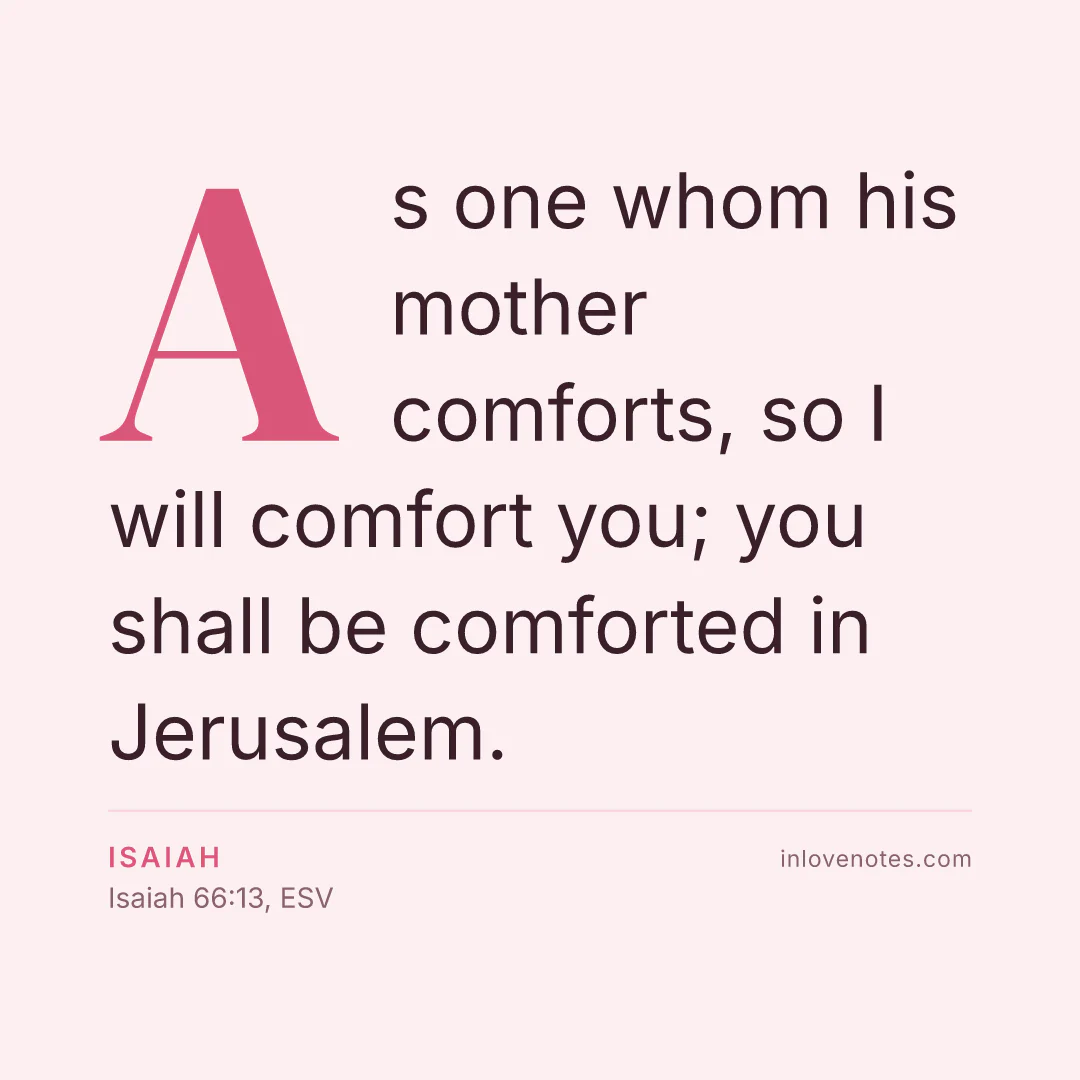
As one whom his mother comforts, so I will comfort you; you shall be comforted in Jerusalem.
Isaiah 66:13 (ESV)
The speaker is God, and the promise is made to Jerusalem. The line only works if the reader already knows what a mother's comfort feels like, which is the point of the image: the nearest human picture of being consoled.
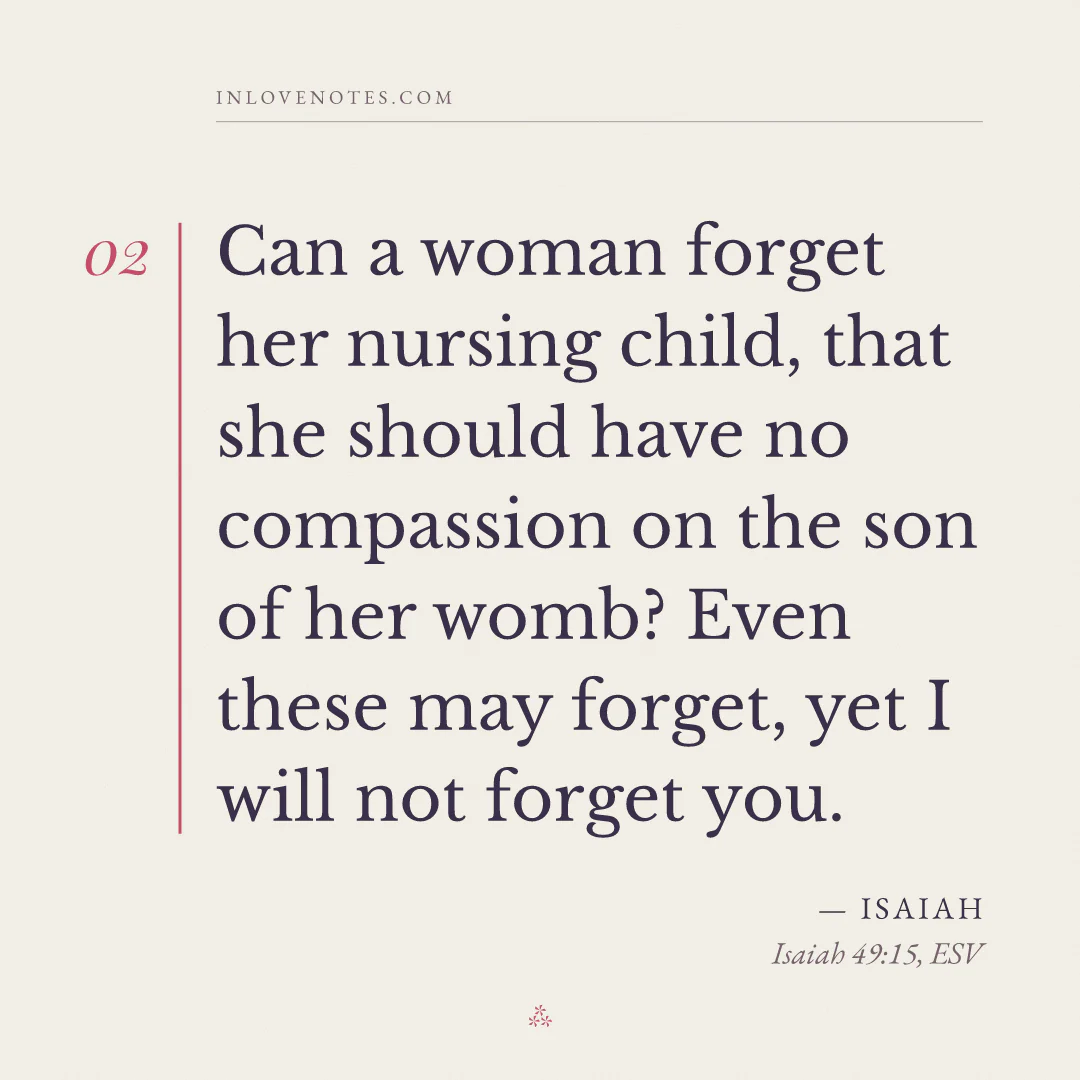
Can a woman forget her nursing child, that she should have no compassion on the son of her womb? Even these may forget, yet I will not forget you.
Isaiah 49:15 (ESV)
The verse before it gives the reason for the question: “But Zion said, ‘The LORD has forsaken me; my Lord has forgotten me.’” (Isaiah 49:14). God answers a complaint of abandonment by pointing to the least likely kind of forgetting, a mother and her nursing child, and then admits that even that can happen. The verse is honest about mothers as well as tender about them, which is why it suits a card for someone who has been the steady one for a long time.
When an apostle describes himself as a mother
But we were gentle among you, like a nursing mother taking care of her own children.
1 Thessalonians 2:7 (ESV)
Here Paul, writing with his companions to the church in Thessalonica, describes how they behaved when they arrived. The next verse continues the thought: “So, being affectionately desirous of you, we were ready to share with you not only the gospel of God but also our own selves, because you had become very dear to us.” (1 Thessalonians 2:8). The nursing mother is the model for giving your own self, not only your words.
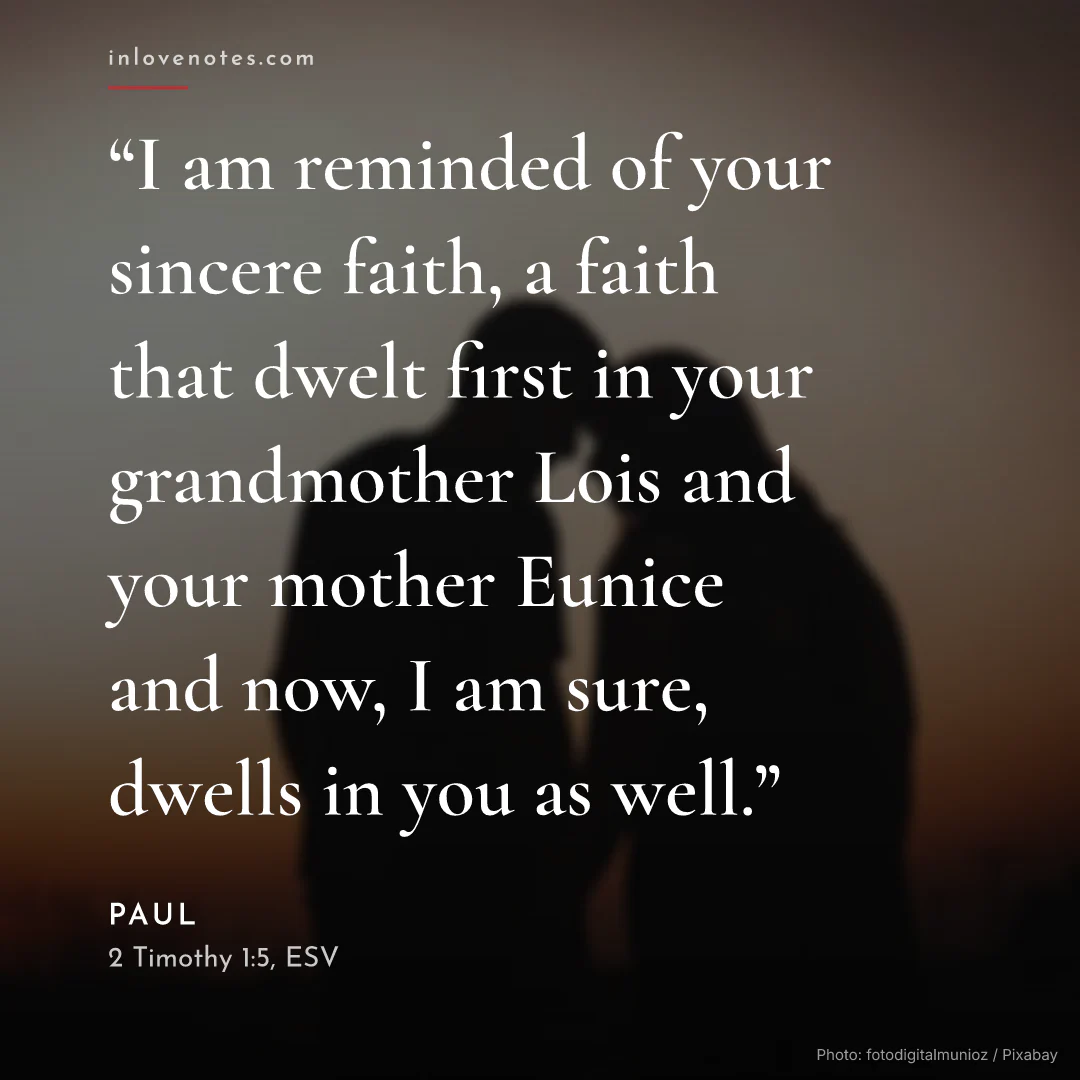
I am reminded of your sincere faith, a faith that dwelt first in your grandmother Lois and your mother Eunice and now, I am sure, dwells in you as well.
2 Timothy 1:5 (ESV)
This is Paul writing “To Timothy, my beloved child” (2 Timothy 1:2) and naming two women, Lois and Eunice, as the people in whom the faith lived first. It is one of the few places in Scripture where a grandmother and a mother are credited by name for what a grown person has become, which makes it a good line for a grandmother's card as well as a mother's.
The mother's teaching in Proverbs
In these two passages the book addresses a son and sets a father's instruction next to a mother's teaching. They honour the mother's voice without claiming it for her alone.
Hear, my son, your father's instruction, and forsake not your mother's teaching, for they are a graceful garland for your head and pendants for your neck.
Proverbs 1:8-9 (ESV)
My son, keep your father's commandment, and forsake not your mother's teaching. Bind them on your heart always; tie them around your neck.
Proverbs 6:20-21 (ESV)
Both passages use the same ornament-and-neck imagery, and both pair the mother with the father. If you quote one on a card, quote both halves: dropping the father's half changes what the verse says.
The rod and reproof give wisdom, but a child left to himself brings shame to his mother.
Proverbs 29:15 (ESV)
This is the hard one. The cost of an unguided child lands on the mother in this proverb, which is a weighty thing to say to a living parent. It is useful for understanding how the book thinks about mothers, and a poor choice for a Mother's Day card.
The mother who taught the famous poem
Proverbs 31 opens with a detail that many readers skip: “The words of King Lemuel. An oracle that his mother taught him” (Proverbs 31:1). So the long poem that follows, the one with the line below, is presented as a mother's teaching.
Her children rise up and call her blessed; her husband also, and he praises her:
Proverbs 31:28 (ESV)
In the ESV the verse ends with a colon, because the praise itself comes next: “Many women have done excellently, but you surpass them all.” (Proverbs 31:29). If you copy only the first half onto a card, end it with a full stop and say that it is a quotation from Proverbs 31:28, not the whole sentence.
Mothers in the Gospels
And he went down with them and came to Nazareth and was submissive to them. And his mother treasured up all these things in her heart.
Luke 2:51 (ESV)
This closes the story of the twelve-year-old Jesus staying behind in Jerusalem after the Passover while his parents searched for him (Luke 2:41-51). The verse is a quiet one: Mary is not given a speech, only an inner life. It suits a card for a mother who noticed more than she said.
When Jesus saw his mother and the disciple whom he loved standing nearby, he said to his mother, ‘Woman, behold, your son!’ Then he said to the disciple, ‘Behold, your mother!’ And from that hour the disciple took her to his own home.
John 19:26-27 (ESV)
Verse 25 sets the scene: “standing by the cross of Jesus were his mother and his mother's sister, Mary the wife of Clopas, and Mary Magdalene.” The passage is about providing for a mother's future, and the last clause, that the disciple took her to his own home, is what makes it practical: care is shown by a place to live.
Honor your father and your mother, that your days may be long in the land that the LORD your God is giving you.
Exodus 20:12 (ESV)
The command is addressed to the child, not to the mother, and it names father and mother together. It is the verse to use when the message is a thank-you from an adult child.
Which verse for which card?
| You want to say | Use | Why it fits |
|---|---|---|
| “You comforted me” | Isaiah 66:13 | The mother's comfort is the picture of being consoled. |
| “You never gave up on me” | Isaiah 49:15 | Answers a fear of being forgotten; read verse 14 with it. |
| “You gave me your whole self” | 1 Thessalonians 2:7-8 | Care that shares “our own selves”, not only advice. |
| “Your faith shaped mine” (mother or grandmother) | 2 Timothy 1:5 | Names a mother and a grandmother as the source. |
| “Thank you for what you taught me” | Proverbs 1:8-9 or 31:1 | The mother's teaching as an honour worn like an ornament. |
| Thank-you from an adult child | Exodus 20:12 | A direct command to the child. |
| Praise from the family | Proverbs 31:28-29 | Children and husband speak; give both verses. |
Questions people ask about these verses
Which Bible verse says a mother's love is like God's?
Isaiah 66:13 and Isaiah 49:15 both use a mother's comfort and compassion as the picture of how God treats his people. Both are spoken by God, not by a mother.
Is there a verse that praises mothers by name?
Not a list of mothers, but several. 2 Timothy 1:5 names Lois and Eunice, and Luke 2:51 and John 19:25-27 name Mary at two points in her son's life. Proverbs 31:1 says the Proverbs 31 poem is what King Lemuel's mother taught him.
Can I use a shortened verse on a card?
Yes, if you say so and the cut does not change the meaning. Proverbs 1:8 and 6:20, for example, mention the father and the mother together, and Proverbs 31:28 ends with a colon that leads into verse 29, so shortening those changes what the reader gets.
For more on this theme, see how Scripture measures a mother's sacrifice, short verses for mothers in long seasons and verses for a tired mother seeking strength. If you are writing the card yourself, how to start and end a handwritten note has openings and closings you can adapt.
Sources: all verses quoted from the English Standard Version on BibleGateway (biblegateway.com), checked on 2026-10-18.