5 Hindi Love Quotes for Her, Sourced, With English Meaning
Five love couplets for her by Ghalib, Mir, Faiz and Dushyant Kumar, in Devanagari, Roman and English, with what each means and how to use it.

Most of the "Hindi love quotes" people share are really Urdu couplets, written in the Perso-Arabic script and read aloud in the same everyday speech that Hindi speakers use. That is why the same sher can appear in Devanagari on a card and in Nastaliq in a book. This page keeps five lines that can be traced to a named poet, gives each one in Devanagari, in Roman letters and in English, says what it means, and then shows you how to write a short line of your own for her.
Wanting more than a lifetime allows
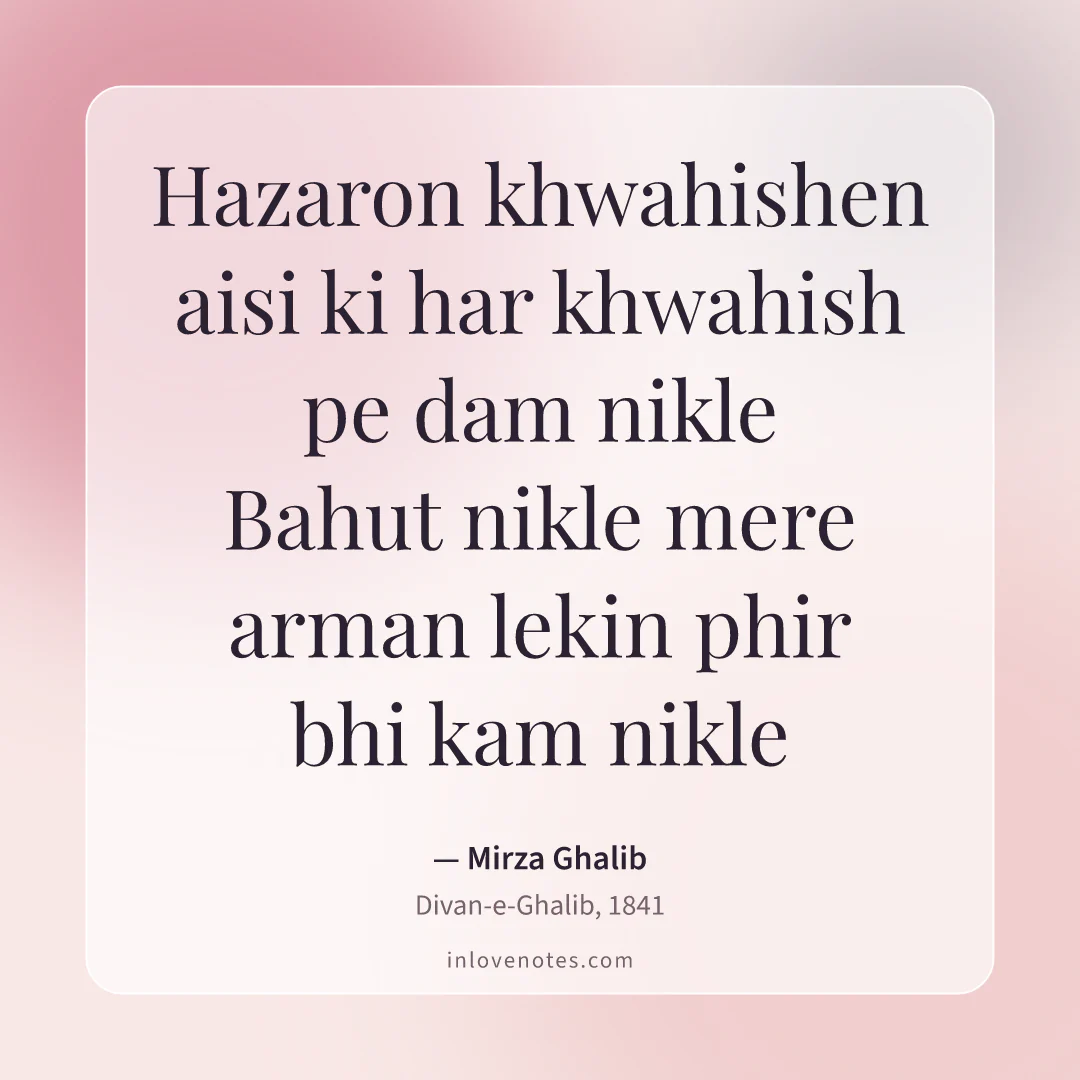
Mirza Ghalib's first divan was printed in 1841 on the lithographic press of Syed Muhammad, Sir Syed Ahmad Khan's elder brother. His best-known opening couplet is about desire that never runs out.
हज़ारों ख़्वाहिशें ऐसी कि हर ख़्वाहिश पे दम निकले
बहुत निकले मिरे अरमान लेकिन फिर भी कम निकलेHazaron khwahishen aisi ki har khwahish pe dam nikle / Bahut nikle mere arman lekin phir bhi kam nikle
"I have thousands of wishes, each so strong it could cost me my breath. Many of my longings were fulfilled, and still too few." — Mirza Ghalib, Divan-e-Ghalib
Ghalib is not complaining about one lover here; he is describing a heart that wants more than any life can give. Sent to a partner, it says something generous: you have given me a great deal, and I am still greedy for you. It suits an anniversary card better than a quarrel.
A garden that knows, a rose that does not
Mir Taqi Mir (1722–1810) is the older master of the Urdu ghazal. This opening couplet of one of his most sung ghazals was filmed in Ek Nazar (1972) and recorded by Lata Mangeshkar.
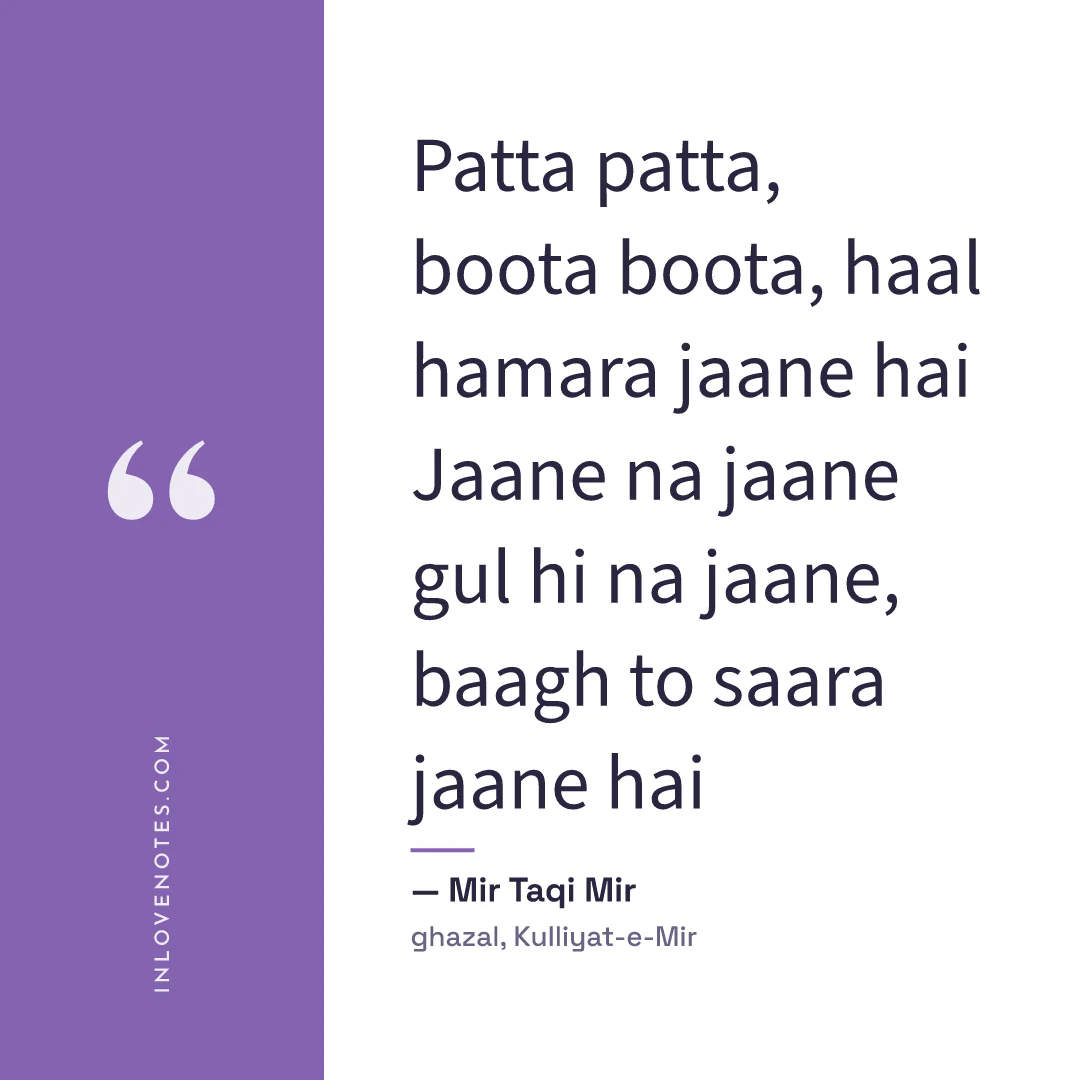
पत्ता पत्ता बूटा बूटा हाल हमारा जाने है
जाने न जाने गुल ही न जाने बाग़ तो सारा जाने हैPatta patta, boota boota, haal hamara jaane hai / Jaane na jaane gul hi na jaane, baagh to saara jaane hai
"Every leaf and every blade of grass knows how I am. Whether the rose knows or not, the whole garden knows." — Mir Taqi Mir, ghazal
The "rose" is the beloved, who is the only one in the garden who has not noticed. It is a good line for a secret admirer, or for someone who has shown their feelings so plainly that everybody except her has guessed. If you are already together, it works as a joke at your own expense: everyone else saw this coming.
A fire nobody can light or put out
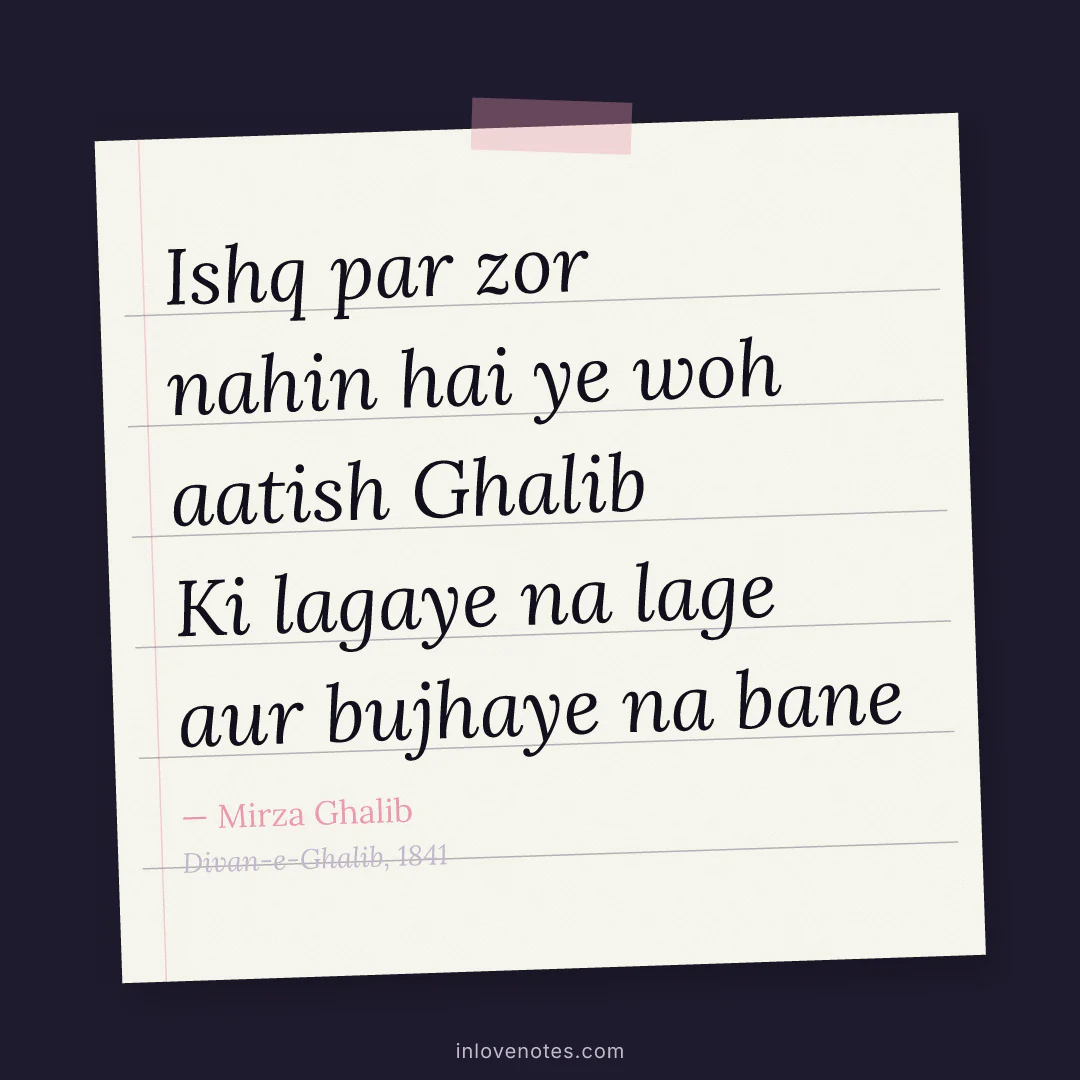
इश्क़ पर ज़ोर नहीं है ये वो आतिश 'ग़ालिब'
कि लगाए न लगे और बुझाए न बनेIshq par zor nahin hai ye woh aatish Ghalib / Ki lagaye na lage aur bujhaye na bane
"Love is beyond anyone's control, Ghalib; it is the kind of fire that cannot be lit on purpose and cannot be put out once it burns." — Mirza Ghalib, Divan-e-Ghalib
The second line carries the idea: you cannot decide to fall in love, and you cannot decide to stop. Use it when a feeling has surprised you, for example in a first confession or a message after a long separation. It is less suitable for a gentle good-morning text; the image is intense.
Two modern voices, two very different moods
Dushyant Kumar (died 30 December 1975) is the poet most associated with the Hindi ghazal, and his collection Saye Mein Dhoop is where this couplet comes from.
तू किसी रेल सी गुज़रती है
मैं किसी पुल सा थरथराता हूँTu kisi rail si guzarti hai / Main kisi pul sa thartharata hoon
"You pass by like a train; I tremble like the bridge beneath it." — Dushyant Kumar, Saye Mein Dhoop
It is a striking picture of how one person can shake another, and it is worth knowing that the poet uses the intimate tu and an image of speed and vibration instead of flowers. The English line quoted above is the translation published with the couplet by the news site Ummid; the Roman spelling varies between sources.
The next line is a warning rather than a compliment. Faiz Ahmad Faiz opens a famous poem in Naqsh-e-Faryadi with:
मुझ से पहली सी मोहब्बत मिरी महबूब न माँग
Mujh se pehli si mohabbat meri mehboob na maang
"My love, do not ask me for the love I once gave you." — Faiz Ahmad Faiz
Many people quote this as a romantic line, but it is the opposite of a promise: the poem says the world's troubles have changed what the poet has to give. Wikipedia describes it as the point where Faiz moves from early romantic verse to socially conscious poetry. Quote it only if you want to say that love has grown up, and expect her to ask what you mean.
How each line was checked
| Line | Poet | What we confirmed |
|---|---|---|
| Hazaron khwahishen aisi… | Ghalib | Opening couplet, with translation, on Rekhta; Ghalib's first divan printed 1841 (The Wire, Express Tribune) |
| Ishq par zor nahin… | Ghalib | Text and translation on Rekhta |
| Patta patta, boota boota… | Mir | Opening couplet on Urdu Shahkar and Rekhta; the dated divan edition was not verified, so no year is given |
| Tu kisi rail si… | Dushyant Kumar | Wording and translation from Ummid; Wikipedia confirms the line is his; no publication year found |
| Mujh se pehli si mohabbat… | Faiz | Opening line and collection on Wikipedia; sources differ on the collection's year, so none is given |
Writing your own line in Hindi
You do not need a classical poet for a good message. Short sentences in everyday Hindi land well. The four lines below are our own wording, not quotations, so do not credit them to anyone.
| Devanagari | Roman | Meaning |
|---|---|---|
| तुम मेरी आदत नहीं, मेरी ज़रूरत हो। | Tum meri aadat nahin, meri zaroorat ho. | You are not my habit; you are my need. |
| तुम्हारी हँसी में मेरी दुनिया बसती है। | Tumhari hansi mein meri duniya basti hai. | My world lives in your laugh. |
| तुम्हारे बिना हर ख़ुशी अधूरी लगती है। | Tumhare bina har khushi adhuri lagti hai. | Without you every joy feels unfinished. |
| तुम साथ हो तो रास्ता ही मंज़िल है। | Tum saath ho to raasta hi manzil hai. | With you beside me, the road itself is the destination. |
The word you choose for "you" sets the mood more than any metaphor:
| Word | Feel | Use it for |
|---|---|---|
| तुम (tum) | Warm, equal | Texts and cards to a girlfriend or wife |
| तू (tu) | Very close, poetic | Verse, like Dushyant Kumar's line, or a private joke |
| आप (aap) | Respectful, formal | A first approach, or an older relative |
For longer messages, see long love messages taken from real letters, or short texts to make her smile. Before you post a "quote" you found online, check it against our notes on misattributed love quotes.
Questions readers ask
Are Ghalib, Mir and Faiz Hindi poets?
No. They wrote in Urdu. Their couplets are widely read in Devanagari because spoken Hindi and Urdu share most everyday grammar and vocabulary, which is why they appear in Hindi film songs and Hindi collections.
Can I send these in Roman letters?
Yes, and many readers prefer it on a phone. Spelling varies between sources (khwahishen, khwahishein), so pick one and keep it consistent. Put the English meaning underneath if she reads one script better than the other.
Which line is best for a first message?
Mir's garden couplet is the gentlest, because it hints at your feelings without demanding a reply. Ghalib's fire couplet is a stronger statement and fits a message you are ready to stand behind.